Peptides are delicate biological molecules, and their efficacy hinges significantly on how they are handled and stored. Improper storage can lead to degradation, rendering your research compounds ineffective and potentially wasting valuable resources. This comprehensive guide outlines best practices for peptide storage, ensuring your peptides remain potent and stable for optimal research outcomes.
Why Storage Matters
Peptides are inherently fragile. Their complex amino acid chains are susceptible to various environmental factors that can lead to degradation. Exposure to **heat**, **light**, **moisture**, and repeated **freeze-thaw cycles** can compromise their structural integrity. These stressors break down peptide bonds, alter their three-dimensional conformation, and diminish biological activity. Proper storage is the critical difference between a potent research compound ready to yield meaningful data and an expensive amino acid soup with diminished activity. Understanding these vulnerabilities is crucial for safeguarding your peptide investments.
Before Reconstitution (Lyophilised Peptides)
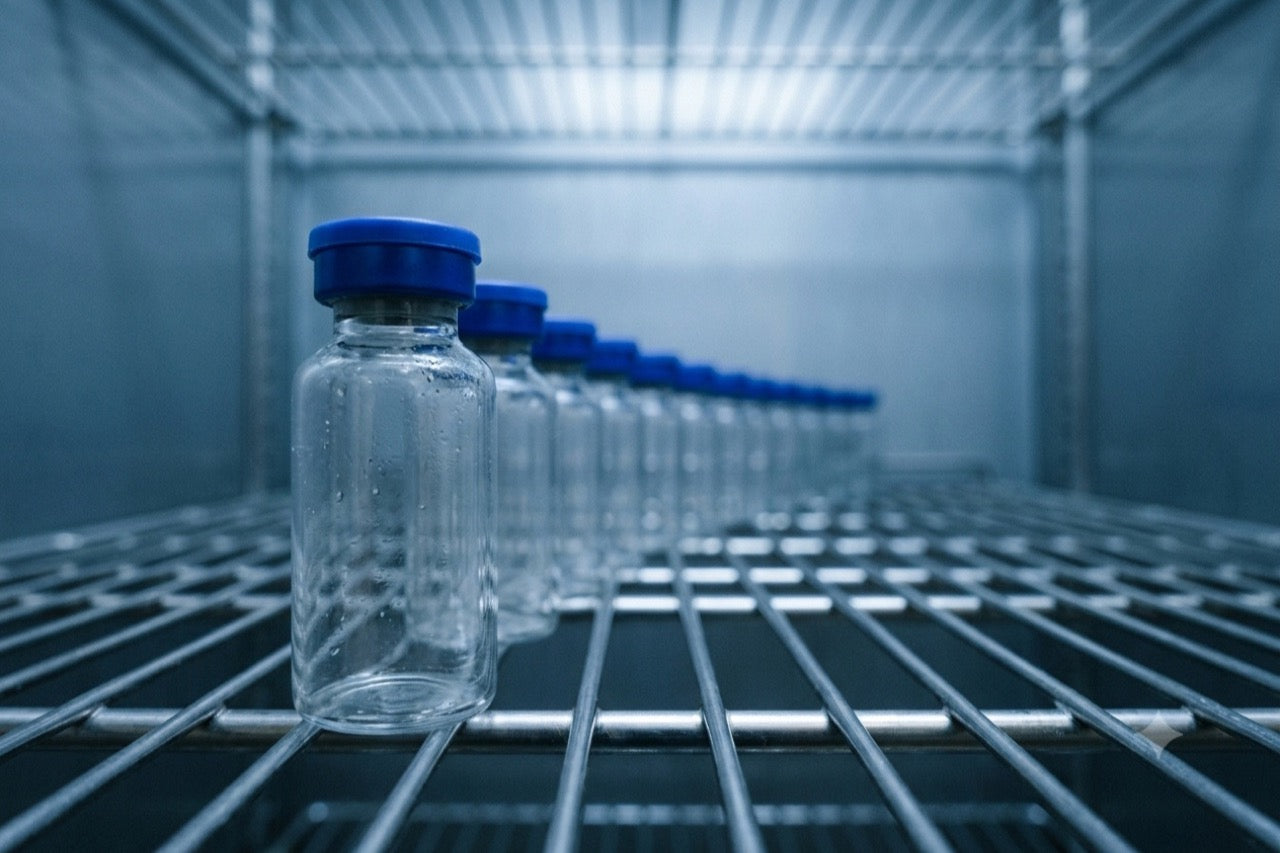
Lyophilised, or freeze-dried, peptides are significantly more stable than their reconstituted counterparts due to the absence of water, a primary medium for degradation. For short-term storage (up to four weeks), most peptides can be kept safely at **room temperature** (around 20-25°C) in their sealed vials.
- For longer storage (up to six months), it is strongly recommended to **refrigerate** lyophilised peptides at 2-8°C. This significantly slows degradation.
- For very long-term storage (exceeding six months), freezing at **-20°C** is the preferred method for maximum potency preservation. For highly sensitive peptides or extremely prolonged storage, -80°C may be considered, though -20°C is usually sufficient and more accessible for most research peptides.
Crucially, always keep lyophilised peptides away from direct light, which can catalyse degradation, and moisture, which can prematurely rehydrate the peptide. The original, sealed vial provides the best protection. Do not open the vial until you are absolutely ready to reconstitute and use the peptide, as exposure to air and humidity can initiate degradation and reduce shelf life.
After Reconstitution
Once a peptide has been reconstituted with a solvent (e.g., bacteriostatic water or acetic acid), its stability significantly decreases. The presence of water makes the peptide more vulnerable to hydrolysis and bacterial growth. Immediate and proper storage is paramount to preserve potency and ensure research integrity.
- **Refrigerate immediately** after reconstitution. Store the solution at 2-8°C. This temperature range inhibits bacterial growth and slows chemical degradation.
- Most reconstituted peptides should be used within **28-30 days**. Always refer to the specific product information sheet for precise recommendations, as stability varies.
- **Do NOT freeze reconstituted peptides.** Ice crystal formation physically damages the delicate peptide structure, leading to irreversible degradation and loss of activity. This common mistake renders peptides useless.
- Keep the peptide in its **original vial**. This minimises exposure to new contaminants and ensures solution integrity. Transferring to new containers can introduce impurities or lead to peptide adsorption.
- Minimise needle insertions into the vial. Each puncture risks introducing contaminants, accelerating degradation and compromising sterility. For detailed guidance, refer to our Peptide Reconstitution Guide and utilise our Reconstitution Calculator for accurate preparation.
Peptide-Specific Considerations
While general guidelines apply, some peptides exhibit unique stability characteristics requiring specific attention. Understanding these nuances is vital for maintaining efficacy and ensuring reliable experimental results.
- **GHK-Cu**: This copper-binding peptide is relatively stable and tolerates a broader range of conditions. Its stability is enhanced by copper complexation. Optimal storage still involves refrigeration after reconstitution to prolong its active life. Learn more about GHK-Cu.
- **BPC-157**: Moderately sensitive to heat, BPC-157 requires careful handling. It should be refrigerated promptly after reconstitution to maintain stability and biological activity. Elevated temperatures accelerate structural breakdown. Find our high-quality BPC-157 product here.
- **GLP-1 Agonists (e.g., Semaglutide, Retatrutide)**: These pharmaceutical-grade peptides often have very specific storage instructions due to clinical applications and precise formulation. Always **follow pharmaceutical storage guidelines** precisely, which typically involve strict refrigeration (2-8°C) and strictly avoiding freezing. Deviating from these instructions severely impacts efficacy and safety.
Travel and Transport
Transporting peptides, whether lyophilised or reconstituted, requires careful planning to protect them from adverse conditions and maintain integrity. Temperature fluctuations and physical agitation are primary concerns.
- For short trips, a **cool bag with an ice pack** is generally sufficient to maintain a stable, cool temperature. Ensure the ice pack does not directly contact vials to prevent accidental freezing.
- **Avoid leaving peptides in a hot car** or any environment with wild temperature fluctuations, such as direct sunlight or uninsulated storage. Extreme heat is a major cause of peptide degradation.
- For air travel, always carry peptides in your **carry-on luggage**. Aircraft cargo holds can reach freezing temperatures, damaging both lyophilised (if unprotected) and especially reconstituted peptides. Keeping them with you ensures a more stable, controlled temperature.
Signs of Degradation
Monitoring peptide solutions for signs of degradation helps identify when a compound may no longer be suitable for research. While some changes are subtle, others are obvious indicators of compromised integrity.
- **Cloudiness or particulate matter** in the reconstituted solution: While some peptides naturally exhibit slight cloudiness or visible particles, a sudden or significant change in clarity, or new precipitates, can indicate degradation or bacterial contamination. Always check product notes for expected appearance.
- **Colour change**: Any noticeable alteration in the solution’s colour from its original state strongly indicates degradation. Peptides are typically clear or faintly coloured; a shift to yellow, brown, or other hues suggests chemical breakdown.
- **Unusual smell**: A change in odour, particularly a strong, foul, or unpleasant smell, suggests bacterial contamination or significant chemical breakdown. Healthy peptide solutions should be largely odourless.
If you observe any of these signs, it is best practice to discard the peptide and use a fresh batch to ensure research integrity and reliability. Using degraded peptides leads to inconsistent or erroneous experimental results.
Ready to Optimise Your Research?
Ensuring the longevity and potency of your peptides is crucial for reliable research outcomes. By adhering to these comprehensive storage guidelines, you can protect your valuable investment and maintain the quality and efficacy of your compounds. Proper storage is not just a recommendation; it’s a fundamental aspect of responsible peptide research. For more in-depth information on peptide handling, reconstitution, and safety, we encourage you to visit our Frequently Asked Questions (FAQ) and Peptide Safety pages.
Explore our full range of high-quality research peptides and related products today to ensure you have the best compounds for your studies: